Energy bills that won’t budge. Rooms that bake in summer and chill in winter. Condensation on the window frames every morning. If that sounds familiar, your home may be a strong candidate for a passive house retrofit.
A passive house retrofit upgrades your existing home’s insulation, windows, airtightness and ventilation to Passive House principles, so it stays comfortable year-round on very little energy. It goes well beyond a coat of paint or a few solar panels.
What is EnerPHit? You’ll see this word throughout the article. EnerPHit is the Passive House Institute’s certification for existing homes: the retrofit version of the Passive House standard. New builds are certified as a Passive House; retrofits are certified as EnerPHit. Its targets are slightly more forgiving, because an existing home’s orientation and shape can’t be changed.
This article walks through the seven signs, explains the core upgrade measures, covers costs, support and approvals, and finishes with where to start.
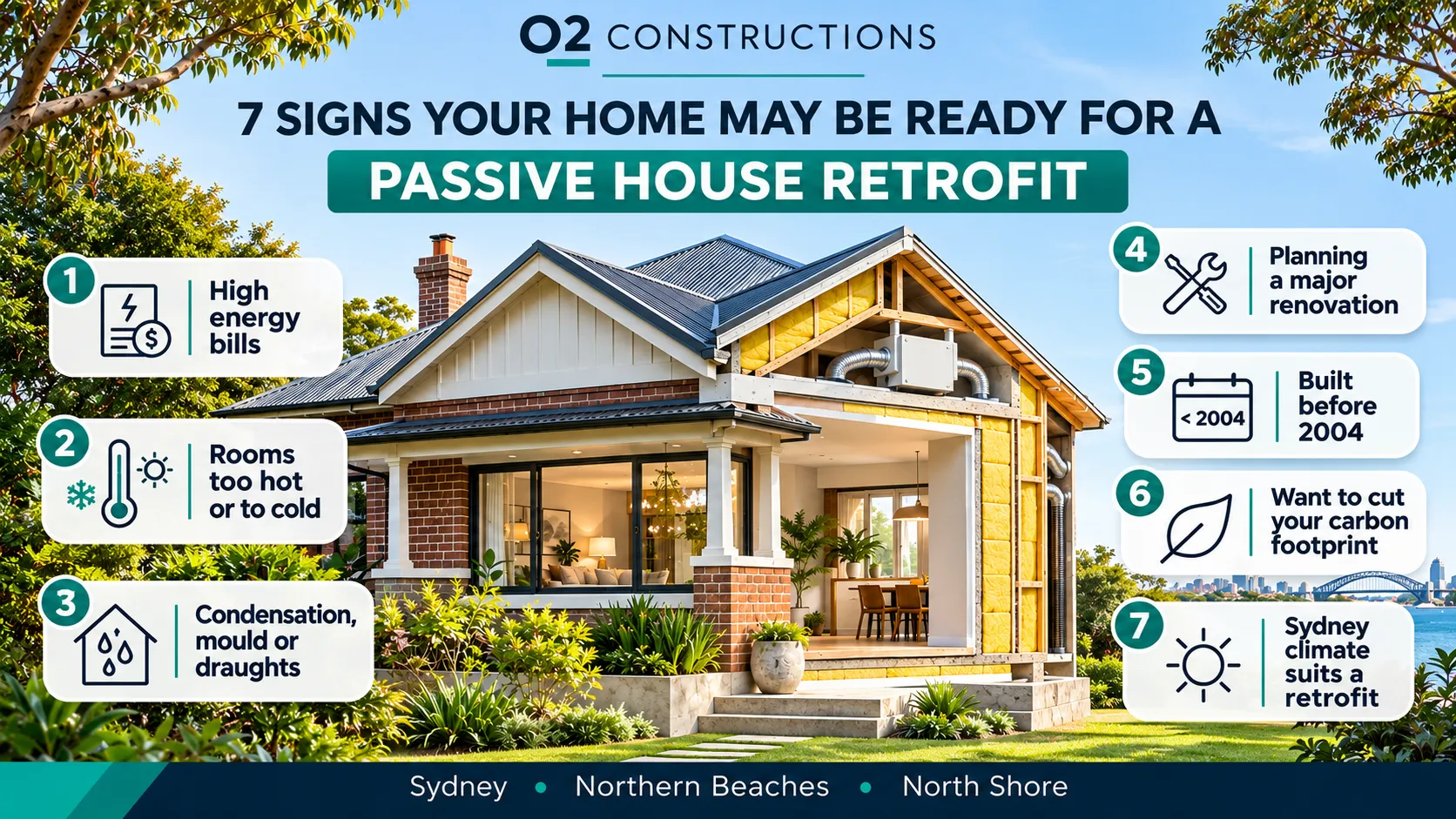
The seven signs at a glance
- Your energy bills won’t come down, whatever you try
- Some rooms are always too hot or too cold
- You live with condensation, mould or cold draughts
- You’re already planning a major renovation or extension
- Your home was built before BASIX came in (2004)
- Cutting your carbon footprint is a genuine priority
- You live in a climate where the returns stack up, like Sydney’s
Key takeaways
- Seven warning signs: a mix of high bills, thermal discomfort, condensation, a planned renovation, older insulation and glazing, a sustainability goal and a suitable climate means a retrofit is worth assessing.
- A retrofit is not cosmetic: a passive house retrofit follows a set sequence, verified through energy modelling, blower-door testing and, for EnerPHit, independent certification.
- You can stage it: an EnerPHit Retrofit Plan, a roadmap of upgrades agreed up front, lets you upgrade in steps. The plan has to be in place before the first step, so early work doesn’t block later upgrades.
- NSW support exists: the NSW Home Energy Saver program offers zero-interest loans of up to $15,000 for eligible upgrades such as insulation and draught-proofing, with discounts of up to $4,000 for lower-income households.
- Start with a feasibility assessment: checking your home before any design work avoids expensive sequencing mistakes.
What’s involved in a passive house retrofit
A passive house retrofit, sometimes called a deep energy retrofit, is a systematic upgrade of the building envelope and mechanical services to meet performance criteria set by the Passive House Institute. To be certified as EnerPHit, the design is modelled in the Passive House Planning Package (PHPP, the institute’s energy modelling software), checked by an accredited certifier and verified with an independent blower-door test.
The five core upgrade measures
Every EnerPHit project works through the same five principles:
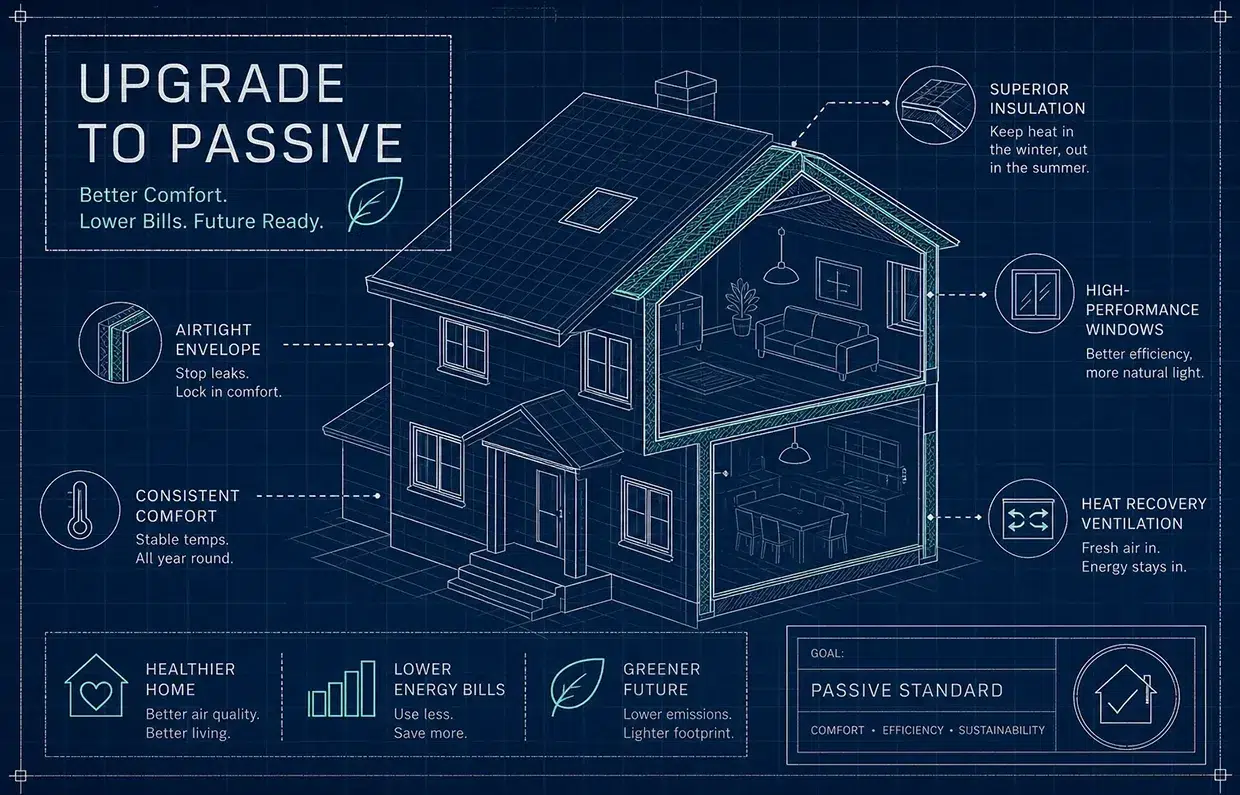
- Continuous insulation designed around the full building envelope
- High-performance windows and doors, thermally broken and double or triple glazed
- Whole-house airtightness, using membranes, tapes and carefully sealed penetrations
- No thermal bridges at wall, floor and roof junctions
- Mechanical ventilation with heat recovery (MVHR), which supplies filtered fresh air while keeping conditioned air in
In Sydney’s warm temperate climate, the balance shifts. Solar shading, controlled ventilation and well-targeted insulation matter more than the heavy insulation used in cold climates. Ceiling insulation, external shading on east and west windows, and selective glazing upgrades usually deliver the biggest gains.
Staged retrofit or whole-house upgrade
An EnerPHit Retrofit Plan maps out every upgrade, in order, before work starts. It lets you upgrade in stages rather than all at once, which helps households manage both budget and disruption. The catch is that the plan must be in place before the first measure begins. An early decision made in isolation, such as installing a new ceiling without an airtightness membrane, can block later upgrades and be expensive to undo.
For a step-by-step look at the upgrade process, read Upgrading an existing home to passive standard.
Signs 1 to 4: performance and comfort red flags
The first four signs show up in how your home feels and what it costs to run. Most homeowners notice them long before they’ve heard of a passive house retrofit, and they’re often the clearest evidence that the building envelope isn’t doing its job.
1. Your energy bills won’t come down
If your bills stay high after switching to LED lights or replacing an old air conditioner, the problem is likely the envelope, not the appliances. A home losing conditioned air through gaps, thin ceiling insulation and single-glazed windows can’t be fixed with a better thermostat.
2. Some rooms are always too hot or too cold
Rooms that overheat in summer and stay cold in winter, especially upstairs or on the west side, point to a weak thermal envelope. A retrofit that fixes insulation continuity and glazing performance tackles the cause, rather than running the air conditioner flat out to compensate.
3. You live with condensation, mould or cold draughts
Condensation forms when warm indoor air meets cold surfaces, a clear sign of thermal bridging and missing insulation. Mould follows moisture, showing the building fabric isn’t controlling temperature and humidity. Draughts mean gaps in the airtight layer, which an airtightness upgrade seals with membranes, tapes and properly detailed penetrations.
4. You’re already planning a major renovation or extension
This is often the strongest sign of all. If walls and ceilings are coming open anyway, it’s the cheapest and least disruptive time to upgrade insulation, airtightness and glazing. Combining performance upgrades with a kitchen extension or second-storey addition means the access and making-good work only happens once. See our home renovations service.
Signs 5 to 7: strategic and structural signals
These three signs aren’t always obvious day-to-day, but they matter in a feasibility assessment. If one or more of these apply and you’re also seeing signs 1 to 4, a passive house retrofit is worth looking at in detail.
5. Your home was built before BASIX came in (2004)
NSW homes built before BASIX was introduced in 2004 were generally built to much weaker energy standards. If your home has no wall insulation and single-glazed aluminium windows, there’s a large performance gap to close. Because the starting point is so low, these homes often see the biggest improvements from an insulation and glazing upgrade.
6. Cutting your carbon footprint is a genuine priority
If lowering your household emissions matters to you, EnerPHit is worth considering. A certified retrofit reduces the energy needed to heat and cool your home, and certification provides independent proof that the upgrade performs as designed.
7. You live in a climate where the returns stack up
Sydney’s climate suits a well-planned retrofit. Many cold-climate measures add less here, but the measures that matter most, such as ceiling insulation, external shading on east and west windows, whole-house airtightness and efficient reverse-cycle air conditioning, give a strong return. Coastal humidity and hot westerly afternoons make controlled ventilation and shading especially valuable.
How much does a passive house retrofit cost in Sydney?
It depends on the size, age, and condition of your home, as well as the scope of work. Costs are higher than for a standard renovation, mainly due to insulation, high-performance windows, airtightness work, and MVHR, plus design, PHPP modelling, and certification fees.
Payback varies widely from house to house. Australian EnerPHit projects set their design targets in PHPP, so savings should be modelled for your specific home rather than assumed from averages. A feasibility assessment is the best way to get a realistic cost range before you commit.
Government support in NSW
The NSW Government’s Home Energy Saver program can help with some retrofit measures:
- Zero-interest loans of up to $15,000, repaid over ten years, for households with a combined taxable income of up to $210,000
- Discounts of up to $4,000, available later in 2026, for households with a combined income of up to $80,000 or eligible concession card holders
- Eligible upgrades include insulation, draught-proofing, reverse-cycle air conditioning, ceiling fans, rooftop solar and batteries
Double glazing isn’t on the eligible list, so check eligibility and approved providers before you sign anything.
EnerPHit certification and NSW approvals
EnerPHit certification and NSW building approvals are two separate processes that run side by side. Neither replaces the other, and understanding both early avoids delays.
The two paths to EnerPHit certification
The energy demand method models the finished home in PHPP and requires it to meet EnerPHit limits for heating, cooling and renewable primary energy. These limits are more lenient than for a new Passive House, because an existing building’s orientation and form can’t be changed.
The component method instead requires each upgrade, such as insulation, windows and the ventilation system’s heat recovery, to meet set minimum performance values. It suits homes where orientation or shape makes the energy targets hard to reach. An airtightness target applies on both paths.
NSW approvals and BASIX
In NSW, structural changes, new windows and doors, and new mechanical services may need development consent or a complying development certificate. Larger alterations and additions also need a BASIX certificate.
For certified Passive House developments, BASIX offers a Passive House Standard method. It requires MVHR and an on-site blower-door test of no more than 0.6 air changes per hour at 50 Pa, carried out by a tester registered with the Air Tightness Testing and Measurement Association (ATTMA). If your project is a retrofit, check with your Passive House designer or certifier whether this pathway applies.
Where to start
Knowing what’s needed is the first step. The order you follow makes the difference between a successful retrofit and an expensive one.
Start with a retrofit feasibility assessment
A feasibility assessment before any design work prevents costly sequencing mistakes. O2 Constructions’ pre-construction consulting helps homeowners on Sydney’s Northern Beaches and North Shore work out whether a passive house retrofit makes sense.
We look at your home’s construction type, performance gaps for your climate zone, a likely EnerPHit pathway, staged or whole-house options, and an honest view of where your project sits on cost. It tells you whether your home suits the full EnerPHit path or whether selective upgrades will get you most of the benefit for less, before you’re locked into a direction.
For example, take a pre-2004 Northern Beaches home with single-glazed aluminium windows, minimal ceiling insulation and no mechanical ventilation. Staged through an EnerPHit Retrofit Plan, it can become a certified high-performance home with proper airtightness, a controlled fresh-air supply, and far lower energy use year-round. The order matters, and so does a team that understands both the standard and local conditions.
Your next move
If your home shows three or four of the seven signs, a passive house retrofit assessment is well worth it. EnerPHit doesn’t have to happen all at once: a staged EnerPHit Retrofit Plan lets you make one well-sequenced upgrade after another, as long as you set the order before work begins.
The result is a home that uses less energy, stays comfortable whatever Sydney’s weather is doing, has cleaner indoor air and is ready for tighter energy standards ahead. This isn’t only for new builds. Sydney already has certified EnerPHit Plus homes in Willoughby and East Lindfield, listed on the Australian Passivhaus Association project register, showing the standard works in local conditions.
Planning a new build instead? See our passive house builders Sydney service.
Contact O2 Constructions to book a pre-construction feasibility assessment. We’ll give you an honest picture of what your home can achieve, what it will cost and the right sequence for your situation.
Frequently Asked Questions
Will solar panels or new appliances do the same job as a passive house retrofit?
No. Solar panels and efficient appliances lower running costs, but they don’t stop heat and conditioned air leaking out of the building. A passive house retrofit fixes the building fabric first, so every other measure works harder.
Do I need an EnerPHit Retrofit Plan before I start any upgrade work?
Yes. Staging is a real advantage, but starting work without a plan can rule out later upgrades and be expensive to correct. The sequence matters.
Who checks the design and airtightness for EnerPHit certification?
A Passive House Institute-accredited certifier reviews your PHPP model, drawings, product data and blower-door results. An independent blower-door test confirms the airtightness level. If you also use the BASIX Passive House Standard method in NSW, that test must be done by an ATTMA-registered tester.
Can I get government help with a passive house retrofit in NSW?
Some measures qualify. The NSW Home Energy Saver program offers zero-interest loans of up to $15,000 and, for eligible lower-income households, discounts of up to $4,000 on upgrades such as insulation and draught-proofing. Double glazing isn’t currently included.