

How do I find a qualified Passive House builder near me? It’s the right question to start with, because plenty of builders across Australia now use “Passive House” in their marketing, yet genuine certified project experience is far less common than the terminology suggests. Some builders have the credentials and the track record. Many don’t. The challenge for homeowners isn’t finding a name on Google; it’s knowing how to tell the difference between a builder who has truly delivered certified high-performance homes and one who has simply picked up the vocabulary from a trade journal or a weekend course.
This guide gives you a repeatable, practical process for finding a qualified Passive House builder near you, covering where to look, how to verify credentials, and what questions to ask before you sign anything. The kind of specialist you’re looking for won’t be the hardest to find. They will, however, be the easiest to verify. A team like O2 Constructions, with over a decade of hands-on passive home experience across Sydney’s Northern Beaches and North Shore, is a good benchmark for what genuine depth of experience looks like.
Where to search for certified Passive House builders near you
The right search doesn’t start with Google. It starts with industry-endorsed resources that give you a filtered, credible starting point before you open a single website or pick up a phone.
The Australian Passivhaus Association member directory is your primary tool. The APA maintains a listing of Passive House consultants, designers, and builders organised by their role in the industry. Builders appear under the Construction and Project Delivery Professionals category, which covers project managers, site supervisors, tradespeople, and contractors. The APA also maintains a Certified Passivhaus Project Register, where completed buildings are tagged by certification level: Passivhaus Classic, Passivhaus Plus, Passivhaus Premium, EnerPHit, and Low Energy Building. Finding a builder in the APA directory confirms they’re engaged with the professional community. It doesn’t automatically verify their project track record, but it narrows your list significantly.
The Sustainable Builders Alliance directory is a useful complementary resource. Some SBA members hold APA membership or have completed certified tradesperson training, so cross-referencing both directories gives you a stronger longlist. Treat both as a starting point, not a final answer, they help you build a longlist, and the steps below help you build a shortlist.
One word of caution: many builder websites now use “passive house,” “Passivhaus,” or “sustainable design” as marketing language without the credentials to back it up. A builder who is directory-listed, accredited, or certified sits in a meaningfully different category from one who uses the terminology in their copy. Understanding that distinction before you start calling builders will save you considerable time.
What Passive House certifications actually mean and how to verify them
Certification confusion is one of the most common traps for homeowners entering this space. There’s a real difference between a certified project and a credentialled builder, and between “building to Passive House principles” and achieving formal certification.
The two main certification pathways are PHI and PHIUS. PHI, the Passive House Institute based in Germany, applies a global fixed-performance standard with a core airtightness threshold of 0.6 ACH50. PHIUS, the North American body, sets climate-specific targets based on location, building geometry, and floor area. In Australia, PHI is the dominant standard, with projects certified through PHI-accredited certifiers. A PHI-certified home will generally meet or exceed PHIUS requirements, though the two are separate entities with different certification pathways and verification requirements. For most Australian clients, PHI is the benchmark to ask about.
Here’s the distinction that matters most: a builder may hold a Certified Passive House Tradesperson qualification, which speaks to their training, but that credential is not the same as having delivered a PHI-certified building. Ask for both, the builder’s training credential and the project documentation. Request the certificate number and the certifier’s name. Then ask for the blower door test results from the finished building. A legitimate certified project will have documentation covering the PHPP energy modelling and construction evidence reviewed during the build. It will also include a final airtightness test conducted under both pressurisation and depressurisation conditions.
For readers renovating rather than building new, ask specifically about EnerPHit experience. EnerPHit is the PHI retrofit standard, and it represents a separate, often harder-to-achieve credential than standard Passive House certification. A builder who has delivered EnerPHit projects brings directly relevant experience to a renovation brief and understands the specific challenges of air-sealing existing structures.
How do I find a qualified Passive House builder near me? Start with these questions
Once you have a shortlist of directory-listed, credentialled builders, the consultation stage is where you find out whether the experience is real. These questions are designed to separate genuine site expertise from theoretical knowledge.
Start by asking how many projects they’ve taken through blower door testing and what results they achieved. A builder with genuine site experience will describe specific detailing decisions: how they managed penetration sealing, the sequence used for window installation, and how they maintained air barrier continuity across junctions. Vague or theoretical answers are a clear signal. The best builders have encountered the difficult details, awkward service penetrations, tricky wall-to-roof junctions, and can explain precisely how they solved them.
Ask how they coordinate with Passive House consultants, energy modellers, and certifiers during construction, not just during design. Strong builders can explain exactly who manages site QA, how airtightness is tracked during the build, and whether they use inspection hold points before closing up critical junctions. This reveals whether they treat high-performance building as a whole-of-project discipline or merely a design phase consideration.
Ask whether the builder offers any form of pre-construction consulting or feasibility assessment before design is locked in. This question is unusually revealing. Builders with genuine depth know that a passive home project lives or dies in the planning phase. Buildability decisions made before a shovel goes in the ground determine whether the finished building achieves its performance targets. A builder who skips this conversation may not fully understand the downstream risks.
Red flags that should give you pause
The red flags in this market are consistent and predictable. Knowing them before you start shortlisting will save you a wasted consultation.
The most widespread red flag is a builder who claims Passive House experience but cannot produce a certified project with documentation: a certificate number, the certifier’s name, and tested airtightness results. “Designed to Passive House principles” and “Passive House certified” are not the same thing. When a builder uses the former language, probe further before proceeding. Ask what principles were applied, and ask for the documentation that proves those principles were met in the finished building.
Ask a builder to walk you through how they manage airtightness on site, step by step. A builder who can’t describe specific strategies for handling penetrations, window installation sequencing, or pre-testing checks before plasterboard goes on has likely not been hands-on through a certified build. The most common airtightness failure points in Australian passive home construction include service penetrations, window and door perimeters, wall-to-ceiling and wall-to-roof junctions, and trade damage to membranes during later construction stages. A builder who understands this will talk about how they mitigate each one.
A credible Passive House contractor near you will have completed projects they can point you to, homeowners who’ll take your call, and documentation they can share. If a builder is reluctant to provide references, certification records, or a sample QA report from a previous build, that reluctance is itself a data point worth taking seriously.
What a credible Passive House specialist actually looks like
Passive House construction requires a fundamentally different site discipline from conventional building. A builder who has been working within high-performance building systems for ten or more years has encountered and solved the real-world problems that don’t appear in training manuals: difficult air-barrier junctions in existing structures, thermal bridging challenges in complex geometries, and the coordination required to get subcontractors meeting airtightness requirements consistently.
O2 Constructions brings this kind of accumulated, on-site competence to every project across Sydney’s Northern Beaches and North Shore. With more than a decade of hands-on experience in passive and high-performance residential construction, their team understands the specific detailing decisions that separate a certified outcome from a near-miss. That depth of experience is what you’re looking for when you vet any qualified Passive House builder near you.
Pre-construction consulting is a reliable indicator of seriousness. Builders who offer buildability and feasibility assessments before design is finalised understand that a passive home project is won or lost in the planning phase. O2 Constructions structures this service specifically to help clients and their design teams avoid costly surprises before construction begins. When a builder invests this level of thinking into the process before a contract is signed, it signals both technical confidence and genuine commitment to the client’s outcome.
Once you’re satisfied with a builder’s credentials and process, ask to review two or three completed projects in detail. Look for climate-appropriate design decisions, documented airtightness results, and clear evidence of certifier engagement throughout the build. A strong portfolio shows consistent, repeatable performance across different sites and levels of complexity, not just one standout project that features prominently in the marketing.
Shortlisting candidates and making your first contact
After verifying certifications, reviewing portfolios, and conducting preliminary consultations, aim for a shortlist of no more than four builders. When weighing candidates, certified project track record and documented airtightness results carry more weight than marketing claims or pricing alone. A builder who has never delivered a certified project represents a meaningful cost risk, regardless of how competitive their quote looks.
A strong first enquiry covers your project brief, the site location, the target standard (Passive House certified or Passive House-inspired), your rough budget range, and a direct question about the builder’s current availability and pipeline. How a builder responds to this enquiry is itself useful information. One who replies with clarifying questions about your site conditions and design ambitions is telling you something very different from one who replies with generic reassurances.
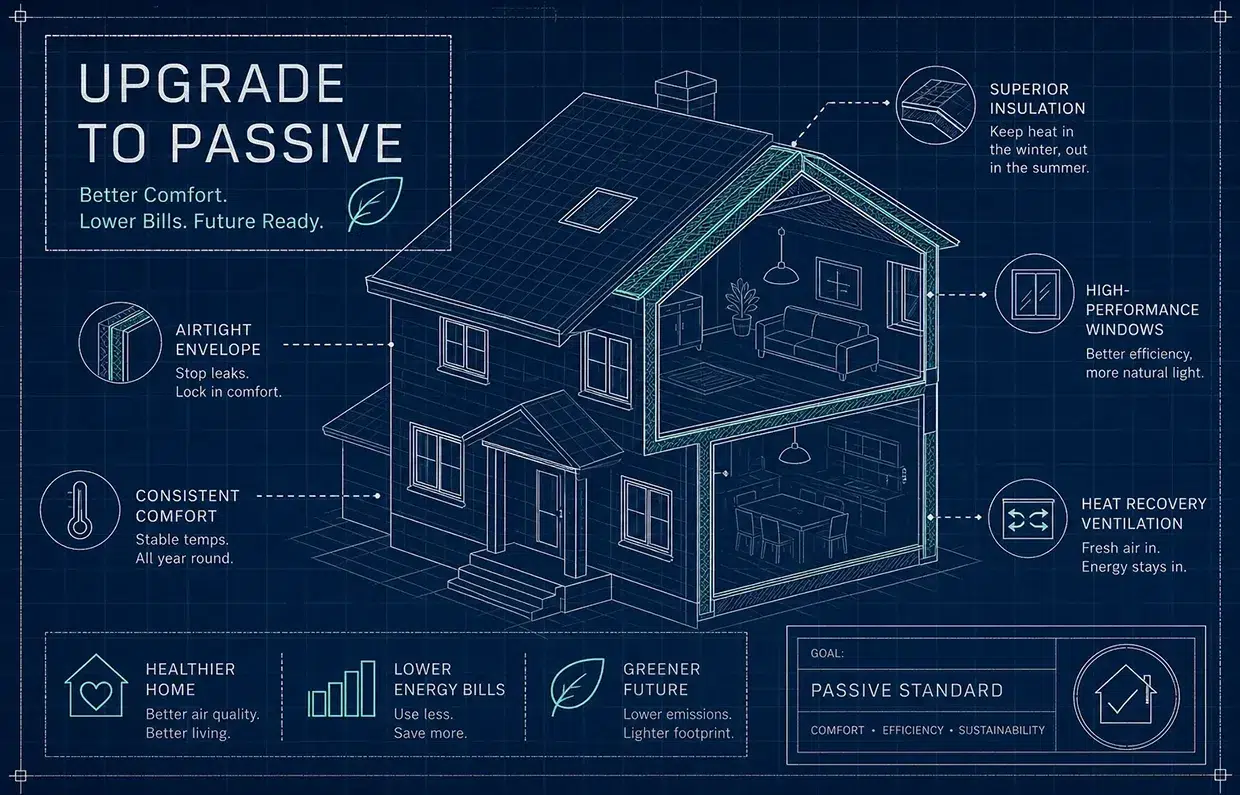
Don’t compare quotes purely on price. Passive House quotes vary significantly based on the level of certification rigour, insulation specification, and window and glazing choices. For a typical 200 m² home in Sydney, the premium for certified Passive House construction over a conventional custom build sits roughly in the range of $31,000 to $66,000, covering certification fees, enhanced insulation, triple-glazed windows, mechanical ventilation with heat recovery, and airtightness detailing. A lower quote from a builder who hasn’t delivered a certified project often means hidden cost risk later. Compare the detail behind the numbers, not just the bottom line.
Finding a qualified Passive House builder near you is a process, not a search
If you’ve been asking yourself “how do I find a qualified passive house builder near me?”, the answer is that the right builder has verifiable certified project experience, clear answers about their airtightness process, a structured approach to pre-construction planning, and references they’re proud to share. Use the process outlined here: start with the APA and SBA directories, verify credentials against actual project documentation, ask the hard questions during consultations, and pay close attention to how builders respond when pressed for evidence.
This process applies whether you’re searching for a Passive House builder in Sydney, Melbourne, Brisbane, Perth, or any other Australian city. The directories, the verification steps, and the right questions remain the same. What changes is the specific site conditions and climate zone, all of which a genuinely experienced Passivhaus builder near you will factor into the conversation from the outset.
If you’re building or renovating in Sydney’s Northern Beaches or North Shore and want to speak with a team that has spent more than a decade delivering certified passive and high-performance homes, O2 Constructions is a strong place to start. Reach out for a pre-construction consultation before your design is locked in. It is also the point where a builder’s genuine depth of experience becomes most visible, before a contract is signed and before anything can go wrong.