

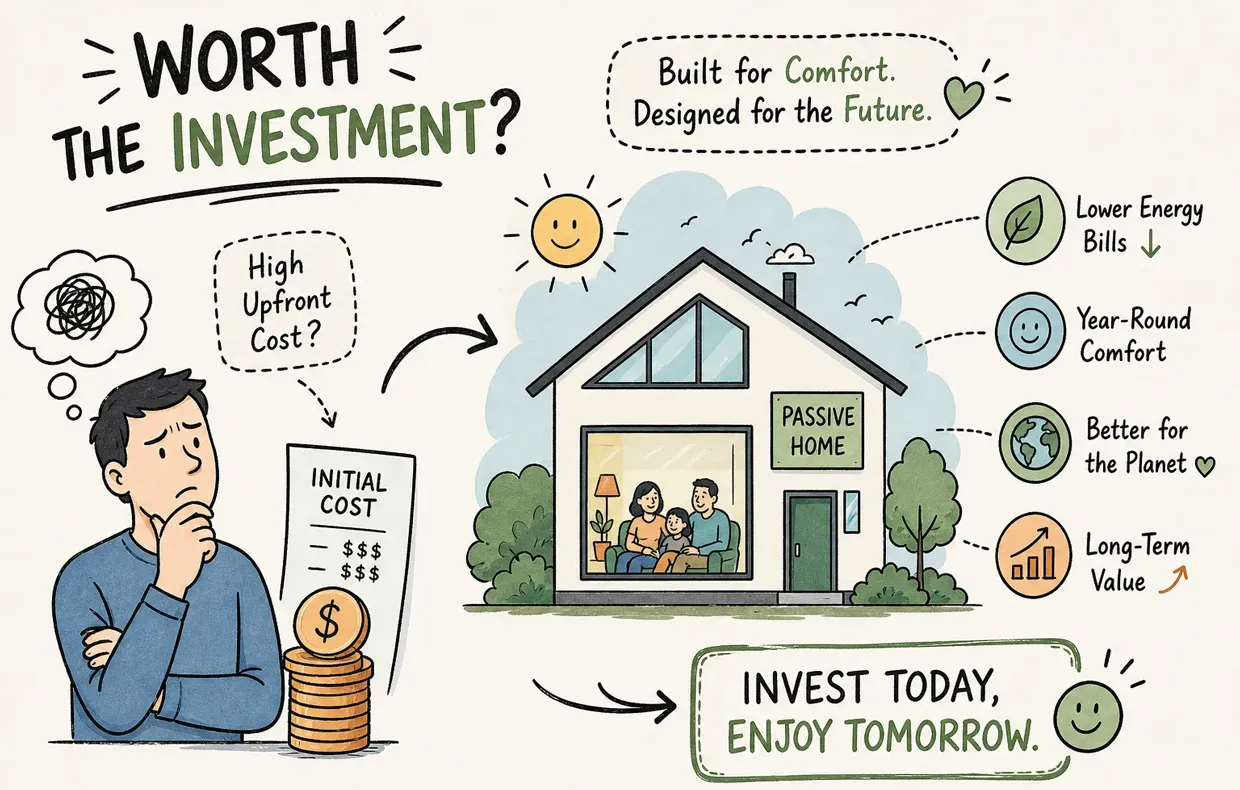
Is building a passive home worth the investment? Well, every person who’s considering one of these homes has to grapple with the same question at some point – is the upfront cost really worth it? The cost is definitely there, upfront and in your face. But the potential long-term savings are pretty enticing – even if they do feel a bit abstract at first. And to be honest, the numbers that really matter rarely get laid out all in one place.
At O2 Constructions, our pre-construction meetings always start with the same question: “What’s this actually going to cost us, and when can we start getting that money back ?” Which is exactly what this article sets out to answer – with the real numbers, upfront and centre.
We’ll take a look at four key areas: the upfront cost, the actual energy savings you can expect, the long-term financial return over 10, 20, and 30 years, and the other benefits that might not show up on your energy bill. By the end, you’ll have a basic framework to work out the numbers for your own situation, not just a national average.
What does building a passive home actually cost upfront?
A certified Passive House, or Passivhaus, in Australia generally costs between 5 – 15% more than a normal new home. Now, if a builder has less experience with airtight construction or can’t easily source the right high-performance parts, that figure can creep up to 10-20%. So on a $400,000 to $600,000 build budget, that’s an extra $20,000 to $120,000. Builders generally reckon that’s about 10-15% more, or around $50,000-$100,000, depending on the specifics of the project.
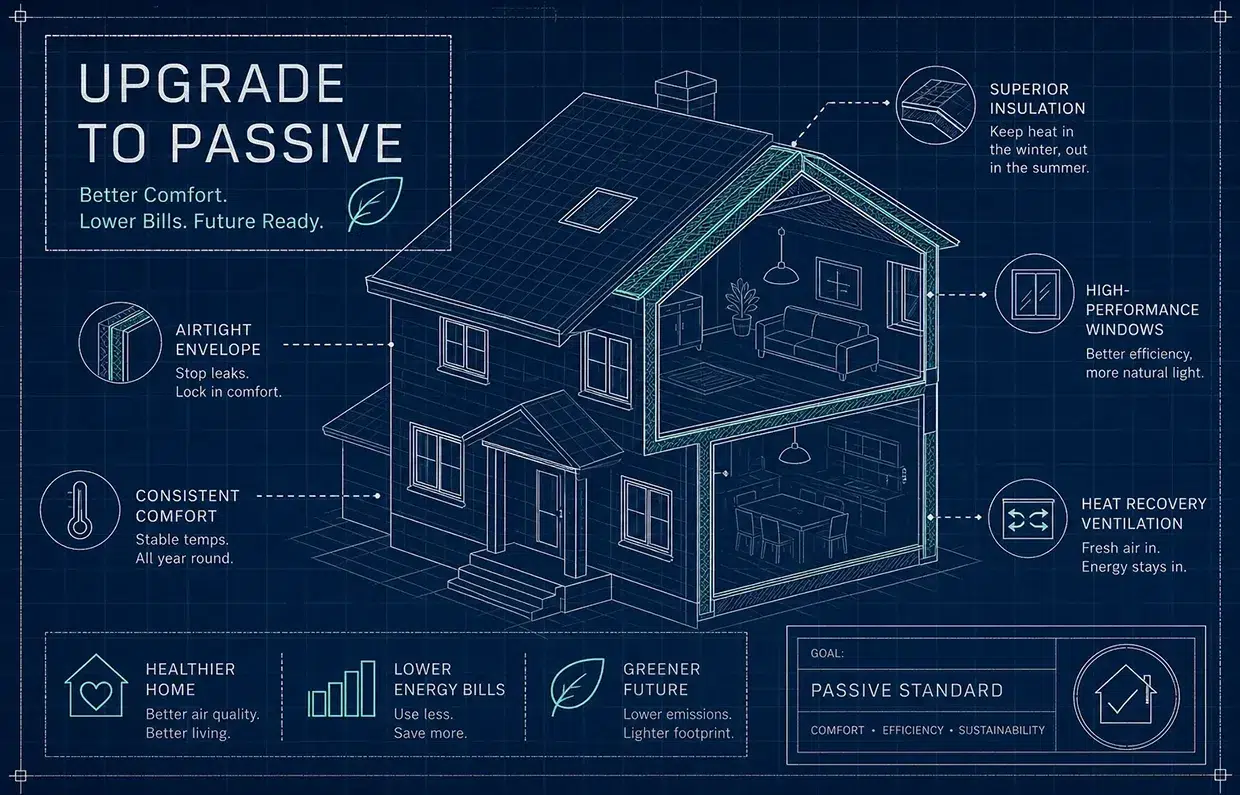
The individual components that drive that extra cost need to be understood – because that’s what’s really driving the bill. Triple-glazed windows with special frames are usually the highest cost. They need to be quoted for individually, rather than just throwing a generic rate per square metre. MVHR (mechanical ventilation with heat recovery) systems can cost $3,000 to $10,000 installed, though top-of-the-line models with extra controls can reach $30,000. And then there’s the Blower-door testing, which is around $1,000 to $3,000. Certification costs, energy modelling, and consultant fees can add another $8,000 to $30,000 to regular design costs.
One key thing that really changes the conversation is what you’re comparing the passive home against. A certified Passivhaus, compared to a basic 7-star home, shows a larger premium than the same home compared to a custom build, which is already pretty well insulated and double-glazed. So people who are already building a high-performance home, regardless of certification, might find that the extra cost of a passive home is only 3-5%. That makes the payback calculation a lot more realistic.
Is building a passive home worth the investment? What you can realistically save on energy bills
The Passive House standard says you should be able to keep the heating and cooling bills under 15 kWh per square metre per year for each. Now, for a conventional home, that’s usually a 70-90% reduction in space-conditioning energy use. For a 150 m² home in a temperate Australian climate, a realistic annual saving is around 1,000-2,500 kWh, or $250-$750 at current electricity prices. In colder climates like Canberra or Melbourne, where heating is a bigger issue, you can expect savings of 2,000 – 5,000 kWh per year – that’s around $500 – $1,500 or more per year.
Real-life examples back this up. A Canberra home that’s part of the Passive House program used 64% less energy than comparable homes, and kept the house at a comfortable temperature for 96% of the year without having the heating or cooling on much. Melbourne modelling is consistent with that – it says a passive home could cut your total energy bill by 68% and save you around $3,051 per year.
Your actual savings will depend on where you live, how many people are in your household, what you pay for electricity, and even what kind of heating system you have. A small home in a mild coastal climate might save $400 per year, while a bigger home in a colder area might save $1,500 or more. Run those numbers against your own situation before you start projecting.
Savings in temperate climates
In areas with a temperate climate, Sydney’s Northern Beaches, for example, have pretty average heating and cooling loads. Annual energy savings for a 150 m² passive home typically range from $250 to $750 per year. The financial argument there often relies more on the comfort benefits, the health benefits of a well-designed home and the fact that it’s easier to sell than a home that’s not well insulated.
Savings in cold climates
In colder climates, such as Canberra, the Blue Mountains, and alpine Victoria, your home will need much more space heating, so the Passive House standard will give you even greater reductions in energy use. And if you model your home properly, you can reasonably expect to save $1,000, $1,500 or even more each year on your energy bills. Which, in turn, means the time it takes for the energy payback to kick in gets shorter and shorter.
The real return on your investment over the next 10, 20 and 30 years
The first ten years are all about comfort and air quality. You’ll save $500, $1,500 on your energy bills each year, which means you’ll get a bit of your money back – around $5,000, $15,000 over that decade – but that’s not the only, or even the main, financial benefit. Long-term owners will appreciate the health benefits, reduced maintenance, and consistent indoor comfort, which really make a difference for households committed to owning a home for the long term.
By year 20, things start to change. You’ll have saved $1,000 to $1,500 per year for 20 years, totalling $20,000 to $30,000. And on top of that, you’ll have avoided a bunch of maintenance costs thanks to a tighter, better-built building envelope. Australian monitoring data and cost studies suggest that the energy payback period is around 10 to 15 years in colder, higher-demand climates, and 20 to 50 years in milder climates with low-energy households, so it really depends on the specifics of your project. There’s no magic formula that will give you an accurate answer.
By the time you’re 30, the financial picture has changed a lot. A home that saves $1,200 a year over thirty years has saved $36,000 in energy costs alone, before you even factor in rising electricity prices. This is also the time when the quality of the building starts to pay off financially: you’ll avoid costly repairs, reduce moisture-related damage from an airtight envelope, and end up with a property that attracts buyers who value documented energy performance. In fact, the resale premium for energy-efficient homes in Australia is estimated at around 9 to 15% in the ACT and broader market data, and a passive home built to Passivhaus standards will be even better off as buyer awareness grows.
The financial value of more than just your energy bills
MVHR systems in a certified Passive House will continuously deliver filtered, temperature-controlled fresh air at the low air-change rates recommended by Passive House ventilation design guidance, while recovering heat from the outgoing air. For households with asthma, allergies, or young kids, this isn’t just a comfort thing but a real health outcome with a real financial impact: reduced medical costs, fewer sick days, and a home environment that supports a good night’s sleep and peak cognitive performance. The Victorian Healthy Homes Programme, which upgraded cold homes rather than installing full Passive House systems, found that they saved $887 less in healthcare costs per person over one winter, which is more than ten times the energy saving for the same period.
A tight, well-built building envelope also reduces the risk of condensation and moisture intrusion – which are two of the most common and expensive causes of building defects in Australian homes. You’ll need far less remediation on a well-built passive home envelope over its lifetime than on a conventional build that doesn’t bother with moisture management. That’s a real cost saving, even if it’s not always visible. And based on cost modelling from high-performance home projects, you can expect routine maintenance costs to be 5 to 15% lower in a well-built high-performance home – which translates to $2,000 to $18,000 over 20 to 30 years, depending on house size and climate.
As buyer awareness of energy ratings grows, driven in part by the NCC’s move to a 7-star NatHERS minimum, it’s raising the floor for all new residential construction. A certified Passive House will blow that standard out of the water, which makes it very attractive to buyers who are starting to ask about running costs before signing a contract. In that sense, building a passive home is also an investment in staying relevant in the market.
Australian incentives in 2026 that can help reduce the upfront costs
No federal or state programme in 2026 will give you a direct rebate for Passive House certification. Design fees, energy modelling, blower-door testing, and certification body fees are excluded from all current programmes, so you’ll need to budget at least $8,000 to $30,000 out of your own pocket to get certified. That’s a key thing to plan for.
But incentives are available for some components typically included in a passive home build. The Small-scale Technology Certificate scheme offers upfront discounts on eligible solar, solar hot water, and heat pump systems; the Cheaper Home Batteries Programme gives you a 30% point-of-sale discount on eligible battery systems; and the Household Energy Upgrades Fund provides discounted finance for insulation, double glazing, heat pumps, and solar through participating lenders. These, though, apply only to the specific equipment, not to the passive home standard itself. State-level help can definitely make a difference in the choice of where you decide to build your home:
- NSW: Home Energy Saver offers up to $15,000 in interest-free finance for eligible upgrades, plus a discount of up to $4,000 that increases the lower your income.
- Victoria: If you’re in Victoria, the Solar Homes scheme offers rebates, and the Victorian Energy Upgrades incentives for energy-efficient appliances and glazing are a great help, though you should double-check that the current programme terms haven’t changed when you’re planning. You can get up to $1,482 towards ceiling insulation (from October 2026, but double-check the current programme terms first).
- ACT: The Home Energy Support scheme provides up to $5,000 in rebates, and the Sustainable Household Scheme offers up to $20,000 in low-interest or interest-free loans to help with electrification and efficiency upgrades.
- Western Australia: If you’re a Horizon Power customer in WA, the Residential Battery Scheme has a rebate of up to $3,800 available for eligible homes.
- Queensland and South Australia: Unfortunately, as of 2026, there aren’t many state-specific schemes for passive homes in these states. But don’t forget that you can still access federal incentives.
It’s always a good idea to double-check your eligibility before signing any contracts. Most schemes require you to use specific products, installers, and follow very specific timelines – so if something looks promising at the planning stage, but doesn’t look quite right once you start digging deeper, it can all fall apart.
Is a passive home the right fit for you?
If you’re considering building a passive home, here’s the million-dollar question: Is Building a Passive Home Really Worth the Investment?
The answer is a pretty straight-out yes for most people who want a long-term owner-occupied home in a temperate or really cold climate. You’ll definitely save some real cash on energy costs, and you’ll also enjoy the health and comfort benefits that come with living in a well-designed home. And if you ever decide to sell, the resale premium is likely to go up as more people look for homes that help them save on their energy bills.
That said, the upfront cost is – yes – not small. $50,000, $100,000 on a standard build, and getting that payback in just 10 or 15 years is going to take a very long time – so it’s worth making sure you’re locked in for the long haul. What you really need is a clear, project-specific picture of what you can expect to save and when, rather than relying on national averages that don’t align with your specific situation.
The cold hard truth
At O2 Constructions, we like to tell it like it is – and the truth is, building a passive home almost always makes sense if you’re planning on owning your home for 15 years or more, and especially so if you live in a cold or temperate climate zone. The maths stacks up if you crunch the numbers correctly and are prepared to put in the time to see it through.
New builds are always easier to get right than a retrofit, since you can build the premium cost into the construction phase, when it’s less painful. But if you do decide to go the retrofit route, you can still cut costs by focusing on just the most cost-effective upgrades – draughtproofing, insulation, heat-pump upgrades – which can start to bring you paybacks in under five years.
Before you even start talking to builders, the most effective step is to conduct a pre-construction feasibility assessment to get a clear picture of the energy savings and costs in your specific situation. We offer this kind of assessment service here at O2 Constructions – get in touch if you’re in the Northern Beaches or North Shore area of Sydney, and we’ll work through all this with you so you can make a decision based on the facts, rather than just getting swept up in industry averages or generalisations.